
By Esme Allman
Content warning: contains images with partial nudity.
On Photography
1.
At the counter, prices flicker on the screen. I ask the difference between .tiff and .jpeg files. The cost is markedly different. The woman winces. I should know this already.
2.
.tiff files are more robust. You can open the files countless times and it won’t matter; its integrity will remain intact, the image itself undisturbed from digital handling. .jpeg files, the cheaper of the two, lose quality each time the file is opened. The degradation is miniscule. A slow chipping away, pixel by pixel. They, however, do not withstand revisiting – are not to be overhandled.
3.
I ponder the price difference. I am paying for the easy access to my film without threat of rupture or destruction.
4.
Image-taking is risky business. I am still learning how aperture and shutter speed work against the light.
5.
But maybe, if I favour .jpegs, I am committing to the sacredness of the image. I am saying I will only revisit you when absolutely necessary. I am forced to be intentional in my film photography, from capture to shoot to development.
6.
I am aware these are colonial terms. Language is failing me.
7.
I think of these bodily ghosts (read: sexual memories) as. jpegs. Their potency striking in the first instances, an uncanny scene felt up and through me. The more the memory is revisited, the less potent it becomes, losing its sharp edges.
8.
I reach for my camera with the same intuition I approach the poem. The intuition is an unsettling of sorts, driving me to root around in the dark, to chase the light.
On Blackness, Ghosts and Hauntings
9.
Saidiya Hartman opens Wayward Lives: Beautiful Experiments explaining her methodology as a ‘grapple with the power and…the authority of the archive and the limits it sets on what can be known’.[1] For her, ghosts and agency are totally bound up. As they ought to be.
10.
As a poet, my limitations are form. I welcome the metric and rhythmic containment to hold my knowledge which has infinite capacity to scale space, place and time.
11.
Institutional practices of epistemology are inflexible. They favour hegemonic stories enabled by the certainty of the archive. In this way they are .tiff files. Robust. The same retelling.
12.
I am a black writer, whose present poetry exists in the ‘afterlife of [trans-Atlantic] slavery’.[2] I encounter ghosts of many kinds. Unforgiving, restless, relentless, troubling. They are also comforting. A reminder that I have been here and everywhere. Poetry is a way of ordering such expansion.
13.
I consider Mary Ruefle’s statement: ‘the moment [poets] are dead, all of their poems about death become poems about being alive’.[3] I think about what this means as a black poet constantly walking among my ghosts. I am perennially haunted. Maybe, I am already dead.
14.
Unforgiving, restless, relentless, troubling. These could be words to describe my poetics; my voice. To describe me.
15.
I marvel at black women. How, historically, we have been embroiled in the physical, sexual and bodily violences of anti-/blackness, and yet, still carry magic. L.H. Stallings states ‘black women use unfettered sexual expression between the human and nonhuman.’[4] When I am catapulted into embodied moments of the past, I remember these too are my ghosts: non-human interactions coloured by the erotic, using the body as a portal.
The Body as a Site of Sexual Memory
16.
Consider the notion that the sexiest things exist in absence. Their temptation to come into being. How well she can conjure sex in an in-/appropriate place. Consider that she is moved not by the thing, but her distance from it. The place where she longs for it.
17.
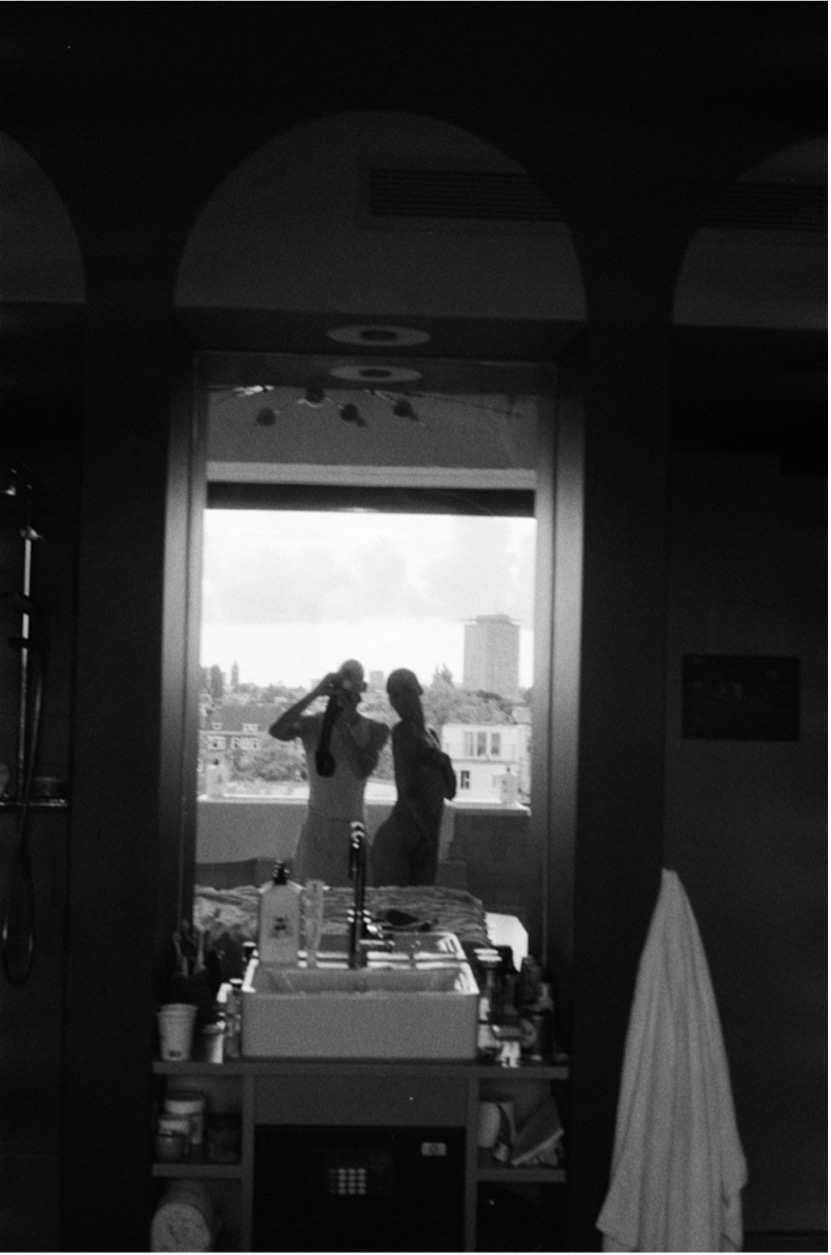
In the photograph, the city juts up in the mirror’s reflection: the building between our heads our punctum.[5] His eye narrows at the viewfinder. My hands protect my modesty.
18.
It is a modest act pouting naked in a mirror after good sex. I remember saying something to this effect. We laugh trying to regain stillness. The shutter clicks.
Figure 7. Figure 1. Bodies in Amsterdam, Personal Archive, July 2025.
19.
I do not mind that I am naked, nor that someone else saw me in this image before I did. We are portals. I see him in the mirror looking back at me through the lens. In a dark room, just off Oxford Street, the person developing the photograph happens across our portal, disheartened only by its out-of-focus-ness.
20.
My nudity is inoffensive. His grey tracksuit and vest are more suggestive. The way that clothes can outline and accentuate. How conditional they are. Clothes can peel off bodies and pool at socked feet.
21.
I am not the pornography in this image. I am explicit only in the act of capture.
22.
There it is again. The language failing.
23.
In Nikki Giovanni’s Seduction the poem ‘is all about breaking rules[…]the woman not only strips off her own clothes, she also strips off those of the man in the room’.[6] My photograph is an effort towards a similar subversion. Pornography’s racial and gender norms, informed by the colonial imagination, are agitated by the presence of our bodies; black and white stood next to each other, the agency resting in the unclothed and soon to be unclothed.
Memory, Ghosts and Place
24.
Seven years ago, I was in Newcastle for the first time auditioning for drama school. When I introduced myself to the panel, my name seemed to be an echo in someone else’s mouth, a knuckle rapping at the door of my teeth.
25.
Now, I spend the first two days walking the same stretch of street. I slip into the university by climbing a set of stone stairs. On my right, a square patch of wildflowers, that are planted next to pink petaled bushes. The well-groomed gardens against redbrick, the air of history lingering as I head to my seminar room. For two days, I do not deviate from this route.
26.
We waited in a conference room to hear if we were invited back to the second audition in the afternoon. I pre-emptively booked an advanced single ticket for the evening.
27.
In 2019, I prepared to escape my history degree for a vocation in acting. In 2026, I was now a poet, using history, performance and literature as a means to communicate with the world. Newcastle, a city I visited only once before, now teemed with meaning. I was confronting an old failure in a new reality. When I passed any mid-range, mildly dilapidated building that could have been the old hotel I auditioned in, the embarrassment stung afresh. I had exposed myself in that audition room. Made myself a fool.
28.
Why did I think I could outrun history?
29.
2019: The audition panel flash me a taut smile. I smile back, chuckling at nothing. They murmur something between them. My cheeks begin to hurt. I cling to anything that feels like hope. The panel do not give. I tear up, not in character. They ask me to remove my shoes, splay my palms and push the wall. I cry, back turned away from them. My best friend wires me the money for an early train home.
On Poetry, Form and Containing the Ghosts
30.
Toni Morrison said, ‘no matter how ‘fictional’ the account of these [black] writers, or how much of it was a product of invention, the act of imagination is bound up with memory’.[7] Morrison makes the black lived experience permissible through writing. I am grateful for the ghost she has become.
31.
‘My ancestors were superfreaks, and I have clearly become a conduit for their continued activities in the afterlife’[8] Stallings jokes. I read and chuckle in agreement. My poems are erotic and, reach to put feeling into form. The feeling can be inherited which is to say ancestral; historical; epigenetic.
32.
Poetry owes history nothing. Accurate depictions of events often sterilise my poems.
33.
I, however, owe the poem the creativity of what memory can offer. A playful account, intuiting remembered events. We owe poetry our courage towards invention.
34.
I return to the photograph an impetus to make. The poem is another way of distilling my intuition. A photo is another way of capturing my ghost(s), ensuring I am not lost to the archive.
35.
The .jpeg photograph is as the flawed as the poem. I can work with flawed. Flawed requires boundaries and structure just as the poem does.
36.
The miniscule degradation of .jpeg files are another articulation of form.
37.
As an ekphrastic poet, my practice is both visual and linguistic. As a black poet, my practice is intuitive, informed by lived experience and ancestral knowledge. I am committed to making our lives – our desires, our bodies, our erotics – legible.
38.
I return to the future, where I am chasing light. I rummage in the dark where the stuff of my poems live. A breath tickles my neck. A bout of electricity grips me. I am grateful for the ghosts in that dark. We are one in the same.
Esme Allman is a poet, writer, and creative facilitator based in Bristol. Her work explores history, desire and anticolonial human relationships with ecological landscapes. Her debut poetry collection, Sweet Bone Girl, was published by Broken Sleep Books in March 2025.
Bibliography
Adukwei Bulley, Victoria. ‘The Ultra-Black Fish’ in Granta. Published May 2022. Accessed on Thursday 16th July 2026 https://granta.com/three-poems-victoria-adukwei-bulley/
Carson, Anne. The Albertine Workout, published by New Directions Publishing, 2014.
Giovanni, Nikki. ‘Seduction’ in Poems Nikki Giovanni: 1968 – 2020. Published by Penguin, 2020.
Hartman, Saidiya. Wayward Lives, Beautiful Experiments, published by Serpent’s Tail, 2019
Malcolm, Cheryl Alexander. (Un)Dressing Black Nationalism: Nikki Giovanni’s (Counter)Revolutionary Ethics’ in “And Never Know the Joy”: Sex And The Erotic In English Poetry, edited by Barfoot, C.C., published by Rodopi, 2006, http://dx.doi.org/10.1163/9789401203401, accessed 14th July 2026.
Morrisey, Sinead. Seminar: ‘Poetry, Photography and the Hauntings of History’, Newcastle University, 29th June 2026.
Morrison, Toni. The Site of Memory in A Mouthful of Blood. Published by Vintage 2019.
Ruefle, Mary. Madness, Rack and Honey, published by Wave Books, 2012.
Sharpe, Jenny. “A Very Troublesome Woman” Who Speaks for the Morality of Slave Women? in Ghosts of Slavery: A Literary Archaeology of Black Women’s Lives. Published by University of Minnesota 2004. Accessed on 13th July 2026. https://www.jstor.org/stable/10.5749/j.cttts67j.8
Stallings L. H., Funk the Erotic: Transaesthetics and Black Sexual Cultures, The New Black Studies Series, published by University of Illinois Press, 2015. Accessed on 13th July, https://www.jstor.org/stable/10.5406/j.ctt16d68qx.
Works cited
[1] Hartman, Saidiya. Wayward Lives, Beautiful Experiments, published by Serpent’s Tail, 2019 (Pgxiii).
[2] Ibid (Pg29).
[3] Ruefle, Mary. Madness, Rack and Honey, published by Wave Books, 2012 (Pg254).
[4] Stallings L. H., Funk the Erotic: Transaesthetics and Black Sexual Cultures, The New Black Studies Series, published by University of Illinois Press, 2015. accessed on 13th July, https://www.jstor.org/stable/10.5406/j.ctt16d68qx (Pg150).
[5] Morrisey, Sinead. Seminar: ‘Poetry, Photography and the Hauntings of History’, Newcastle University, 29th June 2026.
[6] Malcolm, Cheryl Alexander. (Un)Dressing Black Nationalism: Nikki Giovanni’s (Counter)Revolutionary Ethics in “And Never Know the Joy”: Sex And The Erotic In English Poetry, edited by Barfoot, C.C., published by Rodopi, 2006, http://dx.doi.org/10.1163/9789401203401, accessed 14th July 2026. (Pg389).
[7] Morrison, Toni. “The Site of Memory” in A Mouthful of Blood. Published by Vintage 2019 (Pg93).
[8] Stallings L. H. (pg149)

