


Hazel Smith and Sieglinde Karl-Spence
Hazel Smith
Hazel Smith is a writer, performer, new media artist and academic who was born in Leeds, England and emigrated to Australia in 1988. She has published five volumes of poetry including The Erotics of Geography: poetry, performance texts, new media works, Tinfish Press, Kaneohe, Hawaii, 2008 (with accompanying CD Rom), Word Migrants, Sydney: Giramondo, 2016 and Ecliptical, Sydney: Spineless Wonders, 2022. She has also published three CDs of poetry and performance work and numerous collaborative multimedia works, including motions, with Will Luers and Roger Dean, selected in 2016 for the Electronic Literature Collection volume 3 and novelling selected in 2022forthe Electronic Literature Collection volume 4. She is a member of austraLYSIS, the sound and intermedia arts group, has performed and presented her work extensively internationally, has been commissioned by the ABC to write several works for radio, and has been co-recipient of numerous Australia Council for the Arts grants. In 1992 the ABC nominated her collaboration with Roger Dean, Poet without Language, for the prestigious Prix Italia award. In 2017, her multimedia collaboration with Will Luers and Roger Dean, novelling, was shortlisted for the Turn on Literature Prize, an initiative of the Creative Europe Program of the European Union. In 2018 novelling was awarded First Prize in the Electronic Literature Organisation’s international Robert Coover Award. In 2023, her collaboration with Will Luers and Roger Dean, Dolphins in the Reservoir, was shortlisted for the international New Media Writing Prize, UK.
From 2007 to 2017 Hazel was a Research Professor in the Writing and Society Research Centre at Western Sydney University where she is now an Emeritus Professor. She is the author of several academic and pedagogical books including Hyperscapes in the Poetry of Frank O’Hara, difference, homosexuality, topography, Liverpool University Press, 2000, The Writing Experiment: strategies for innovative creative writing, Allen and Unwin, 2005, now published by Routledge (shortlisted for the APA awards) and most recently The Contemporary Literature-Music Relationship: intermedia, voice, technology, cross-cultural exchange, Routledge, 2016. With Roger Dean she co-authored Improvisation, Hypermedia and the Arts since 1945, Routledge, 1997 and co-edited Practice-led Research, Research-led Practice in the Creative Arts, Edinburgh University Press, 2009. She is a co-editor with Roger Dean of the creative arts journal of online sound, text and image, soundsRite, based at Western Sydney University. Hazel previously pursued a career as a professional violinist. Her website is at http://www.australysis.com
Although based in Sydney, Hazel lives three months of each year in London.
Sieglinde Karl-Spence
Sieglinde Karl-Spence spent her childhood years in her native Germany before emigrating to Australia with her family in 1953. She lives in Sydney. Sieglinde trained as a jeweller, graduating in Jewellery and Silversmithing from Middlesex Polytechnic, London in 1978. Since the late 1980s her practice has focused on installation and performance, including works of a site-specific, transitory nature such as Healing Mandala – 365 offerings, Mildura Arts Festival, 1996 and Red Bead Seed Offering, Botanic Gardens, Darwin, 1997.
Sieglinde has exhibited extensively in Australia and internationally, including in the shows Unfamiliar Territory, 1992, Adelaide Biennial of Australian Art, Art Gallery of South Australia, and Crossing Borders: History, Culture and Identity in Australian Contemporary Textile Art, a major survey of Australian textiles that toured throughout the United States of America. In 2002 Sieglinde was again part of the Adelaide Festival of the Arts, collaborating with chef Gay Bilson to produce the Edible-lei Project at the Queen Elizabeth Hospital, Adelaide. Sieglinde has taken part in many artist-in-residency projects in Tasmania, often working with the local community. Recently, Sieglinde has focused on making small transient mandala installations. Her work is represented in most of the major galleries in Australia including the National Gallery of Australia, Canberra; Art Gallery of Western Australia, Perth; Art Gallery of South Australia, Adelaide; Museum and Art Gallery of the Northern Territory, Darwin, NT; Queen Victoria Museum & Art Gallery, Launceston, Tasmania and Museum of Applied Arts & Sciences, Sydney, N.S.W. Her website is at http://sieglindekarl-spence.com.au. Some of her exhibitions have been accompanied by publications including TranceFIGUREd Spirit with Hazel Smith and Graham Jones, Soma Publishing, 1990 and Secret Places with Hazel Smith, Kate Hamilton and Ron Nagorcka, Queen Victoria Museum and Art Gallery, Launceston, 1996.
Brief Description
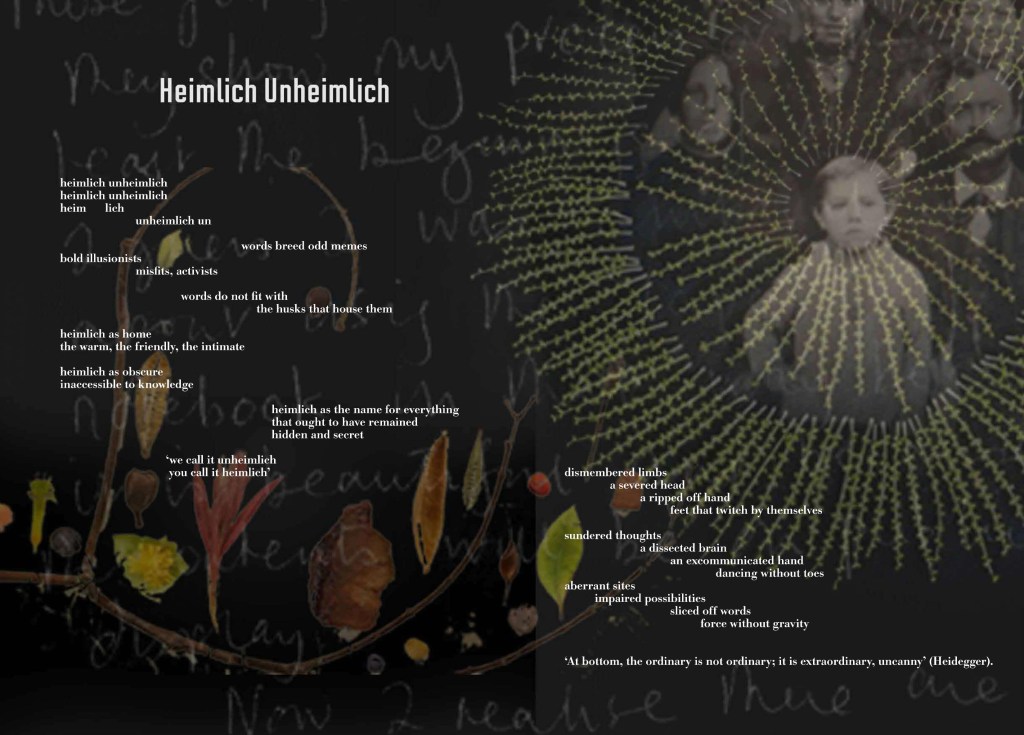
The book, Heimlich Unheimlich uses our contrasting childhoods (Sieglinde Karl-Spence, German-Australian) and (Hazel Smith, British-Jewish) as a starting point. It focuses on two characters who have names related to different kinds of cloth. One is Hessian, a German girl born towards the end of the Second World War, whose father fought in the German army. She migrates with her family to Australia when she is still a child and eventually becomes an artist. The other is Muslin, who is born into a Jewish family in Leeds, England after the war. She is a violinist who subsequently becomes a poet and migrates to Australia as an adult. Her parents live in the shadow of the holocaust and are unforgiving of Nazi Germany. Both Hessian and Muslin are shaped by, but also rebel against, the cultural environments in which they grow up. Heimlich Unheimlich suggests strong crossovers between Muslin and Hessian, intertwining and reconciling their different childhoods. Through the enigma of family photographs, the book explores the post-Second World War period, the blending of personal and historical trauma, the bonds of ethnicity, belonging and migration.
In Heimlich Unheimlich there is a reciprocal relationship between the text and image. The collaged images do not simply “illustrate” the text: the text influences the image and vice versa. Sometimes the relationship between text and image is explicit, sometimes more obscure, posing questions about their joint meanings. The text (which exploits different fonts and spacings) takes on some visual qualities while the visual images influence the way we read the text. The juxtapositions of text and image create tensions between representation and abstraction, continuity and discontinuity. These synergies reinforce the separate but blended identities of the protagonists and the broader social contexts from which they emerge.
Heimlich Unheimlich also takes the form of a gallery installation and art video created by Sieglinde Karl-Spence and Hazel Smith. It was exhibited in the Broadhurst Gallery, Hazelhurst Regional Gallery and Arts Centre, Gymea, Sydney from October 31st to November 17th, 2020, and then again in the Edith Cowan University Gallery, Perth, May 6th to 20th, 2021. The exhibition is currently on show again at the John Mullins Memorial Gallery, Dogwood Crossing, Miles, Queensland, February-March 2023. The exhibition includes a multimedia video made together with Roger Dean and the multimedia group austraLYSIS. The video was selected for the Electronic Literature Organisation’s Virtual Gallery Exhibition, (un)continuity, in 2020, based in Orlando, Florida, USA and is available on that site: https://projects.cah.ucf.edu/mediaartsexhibits/uncontinuity/Smith/smith.html.
 OSMOSIS PRESS